
Chain of Responsibility Pattern in Software Development
By OPA Software · May 31, 2025
You can follow along with my github repo where I implement each design pattern individually. Looking at the code can help you internalize the material so I do encourage you to follow the repo for updates as I continue to develop this course: Design Patterns Repo
The Chain of Responsibility (CoR) is a behavioral design pattern that allows a request to be passed along a chain of handlers. Each handler in the chain either processes the request or passes it to the next handler in the chain. This pattern decouples the sender of a request from its receiver, giving multiple objects the chance to handle the request without knowing which one will do so.
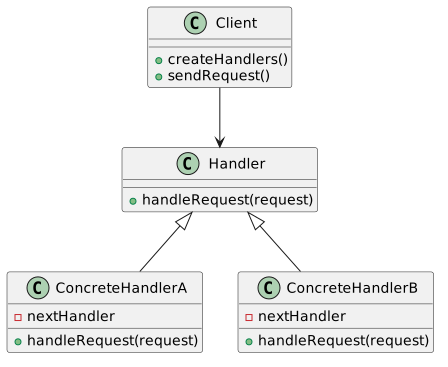
Pattern Structure
The core structure involves:
Handler: An abstract class or interface defining a method for handling requests.
Concrete Handler: Implements the handling logic. If it can't handle the request it forwards it to the next handler.
Client: Sends the request to the first handler in the chain.
Real-World Analogy
Consider a technical support system:
A customer submits a ticket.
The Level 1 support team checks if they can resolve the issue.
If not, the ticket is forwarded to Level 2 support, and so on.
Eventually, the issue is resolved by the first capable support level in the chain.
This decouples the customer from knowing who will fix the issue and allows each support level to handle specific responsibilities.
Software Use Case
A logging framework is a typical software example. You might have several loggers (console, file, email, etc.) chained together. Each logger checks the severity of a log message and either processes it or passes it along. For instance:
A debug message might be handled only by the console logger
An error might be logged to a file and also trigger an email alert
UML Components
Benefits
Flexibility: You can add or remove various handlers easily
Responsibility Decoupling: Sender and receiver are not tightly bound.
Open/Closed Principle: Add new handlers without modifying existing code.
Trade-Offs
Debugging Difficulty: Harder to trace how and where a request is handled
Performance: A long chain might reduce performance due to multiple checks.
Best Practices
Keep the handler chain concise to avoid inefficiency
Use it when multiple objects might handle a request and you do not want to specify the handler explicitly
Combine with logging, UI event handling, or validation pipelines.
Example (Dart Implementation)
You can see an implementation of the chain of responsibility design pattern in my design patterns repo: Chain of Responsibility Design Pattern
Final Thoughts
The Chain of Responsibility pattern is a powerful solution when designing systems that require multiple potential handlers for a request. It provides flexibility, promotes separation of concerns, and adheres to design principles that lead to maintainable code. It is especially useful in event-driven systems, middle-ware pipelines, and support systems.