
You can follow along with my github repo where I implement each design pattern individually. Looking at the code can help you internalize the material so I do encourage you to follow the repo for updates as I continue to develop this course: Design Patterns Repo
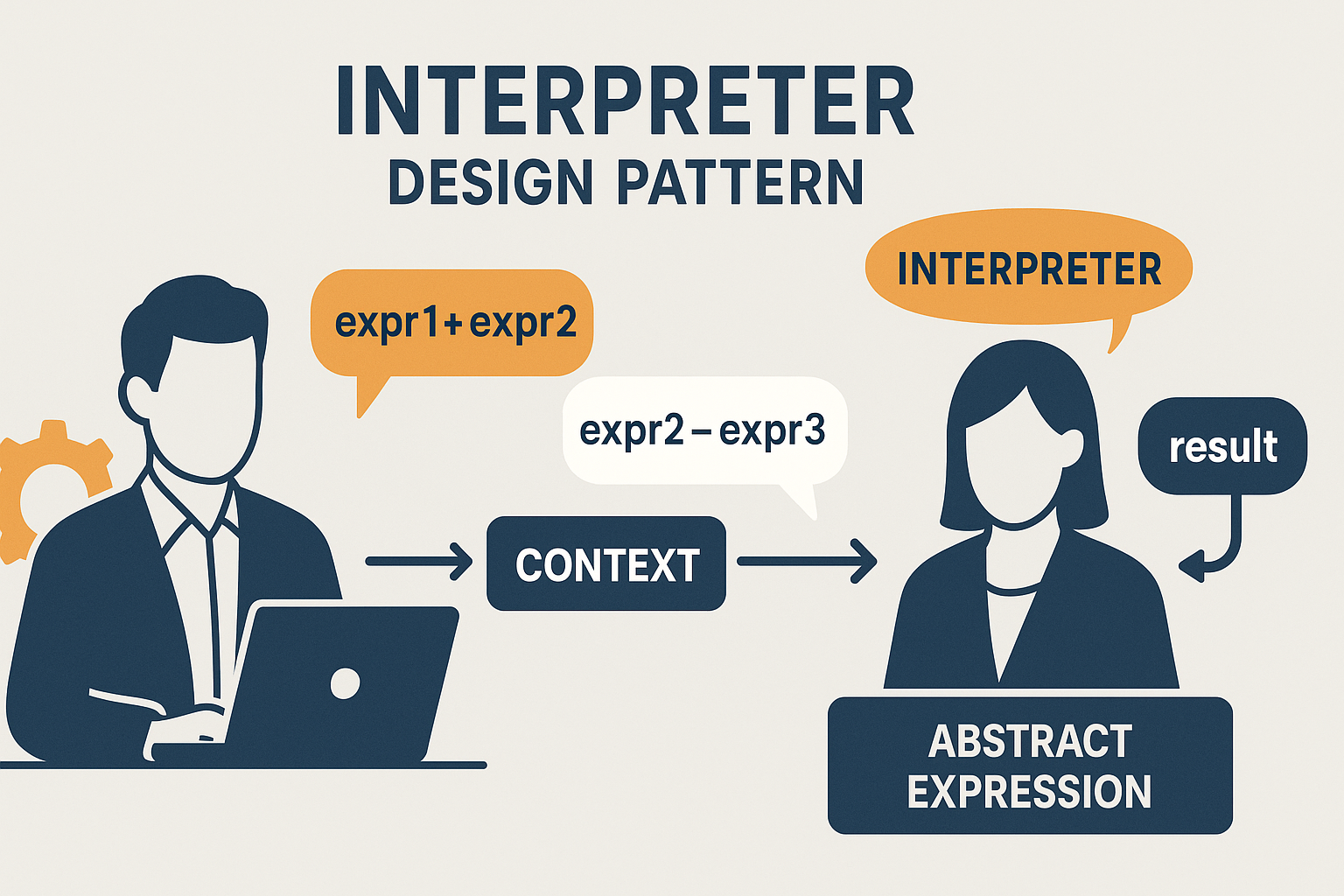
The Interpreter Pattern is a behavioural design pattern that defines a grammatical representation for a language and provides an interpreter to interpret sentences in that language. It is particularly useful when you want to implement a language or notation and need a way to process its grammar.
This pattern helps convert expressions written in a language into executable behaviour by defining a class for each grammar rule. While not commonly used for general-purpose compilers or interpreters (which require more efficient parsing techniques), it's valuable for small and well-defined grammars such as mathematical expressions, command languages, or configuration scripts.
Pattern Structure
The core structure involves:
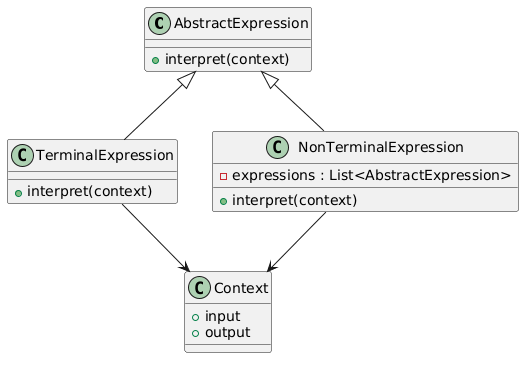
- Abstract Expression: Declares an interface for all nodes in the abstract syntax tree.
- Terminal Expression: Implements an interpret method for terminal symbols.
- Non-Terminal Expression: Implements an interpret method for non-terminal symbols using recursive composition.
- Context: Contains global information used during interpretation.
Real-World Analogy
Imagine a simple calculator that evaluates mathematical expressions written in basic syntax, such as "3 + 5 - 2". Each part of the expression (numbers and operators) is interpreted according to a grammar. The calculator processes this expression one part at a time, following the rules defined by its grammar.
A real-life example would be a basic chatbot script where inputs like "say hello" or "add 2 and 3" are interpreted based on predefined grammar rules, turning those inputs into meaningful actions without using a full parser.
Software Use Case
The interpreter pattern is useful in applications such as:
- Scripting engines in games or business rules
- Query languages for data filtering
- Pattern matching and configuration file parsers
Consider an SQL-like query engine for a reporting tool. The user writes queries like "age > 18 AND country == 'Greece'", and the system interprets this using expression trees created from the grammar of the language. Each node (comparison, logical operator, value) is an expression object that knows how to evaluate itself given a context (user data).
UML Components
Benefits
- Simple: Simple implementation for small grammars
- Extensible: New grammar rules can be added easily by creating new expression classes
- Readable: Grammars are implemented in an object-oriented hierarchical manner
Trade-Offs
- Performance issues: Not suitable for complex grammars due to large numbers of classes and recursive interpretation
- Complex maintenance: with many rules, maintaining the expression classes becomes difficult
Best Practices
- Use the Interpreter pattern for small DSLs or command languages where performance isn't a critical factor
- Combine with the Composite pattern to represent grammar hierarchies naturally
- Avoid for general-purpose programming languages or large-scale parsing
Final Thoughts
Article by